For wear-resistant dredging and mining hoses, we have elaborated on why safety factors matter for product selection and procurement in our prior post. Apart from this, the safety factor is a decisive factor for hose material usage and manufacturing costs. With other specifications unchanged, a higher safety factor means higher raw material costs for the hose. This paper only analyzes raw materials among the three cost elements (material, labor, overhead), excluding labor and manufacturing expenses from the calculation scope. In accordance with ISO 28017:2018 Rubber hoses and hose assemblies, wire or textile reinforced, for dredging applications — Specification, this paper takes Type I non-floating dredging hose with 450 mm inner diameter as an example to break down material cost differences under different safety factors.
1. Basic Sample Parameters
The hose has an inner diameter of 450 mm, a 10 mm lining layer and a 6 mm outer cover, adopting 2000D3 cord. Its maximum working pressure is 1.0 MPa, and different safety factors are achieved by adjusting the number of cord layers:
|
Safety Factor |
Number of Cord Layers |
Minimum Burst Pressure |
|
1.5 |
2 |
1.5 MPa |
|
2.0 |
4 |
2.0 MPa |
|
3.0 |
6 |
3.0 MPa |
|
4.0 |
8 |
4.0 MPa |
This calculation only covers the hose body materials, excluding couplings and fittings.
2. Raw Material Cost Data Under Different Safety Factors
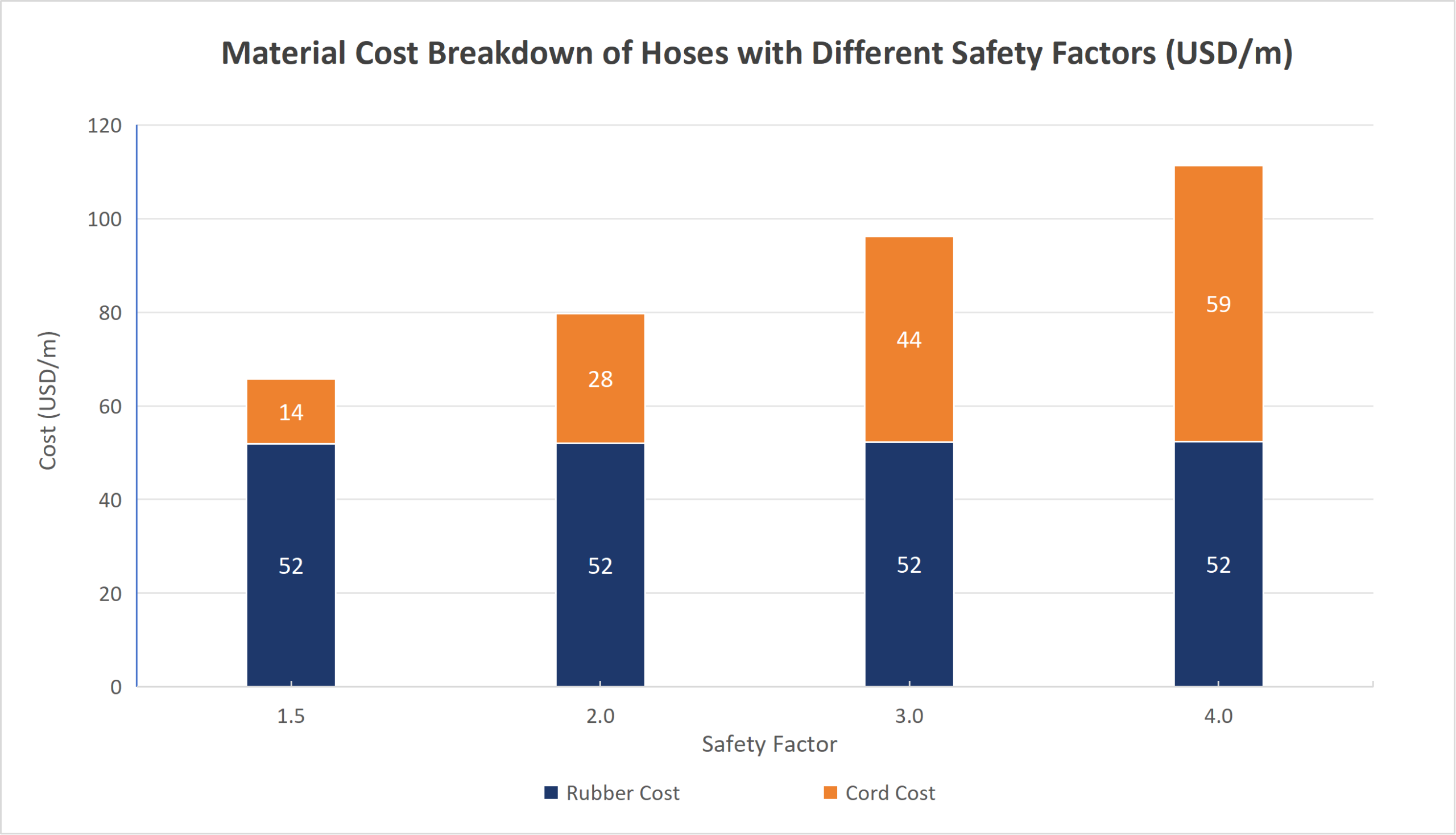
- Cost Composition: The consumption of base rubber changes slightly, while the number of cord layers doubles with the rise of safety factor. Cord cost rises sharply and becomes the core factor widening total costs.
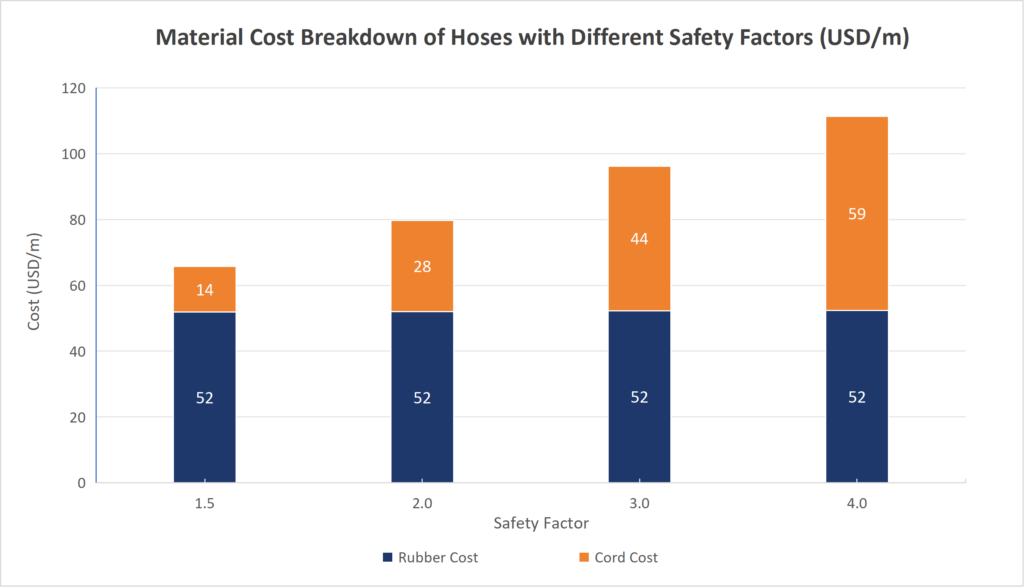
Note: All data are internal test samples of our factory and not universally applicable across the industry, only for principle reference. Raw material prices and manufacturing processes vary over time, so the data shall not be directly used for quotation or procurement pricing.
- Cost Growth Comparison:
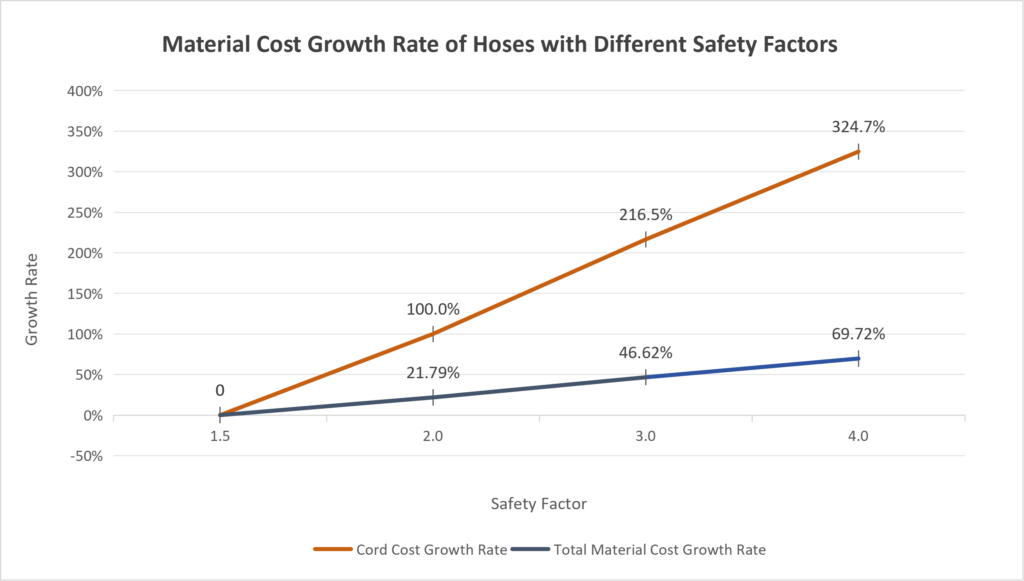
Taking the safety factor of 1.5 as the benchmark, both cord cost and total raw material cost keep rising as the safety factor increases. At the safety factor of 4.0, cord cost rises by more than 320%, and the total raw material cost increases significantly.
3. Core Analysis & Recommendations
Based on the cost breakdown calculation of 450 mm dredging hoses complying with ISO 28017:2018, we can clearly quantify how safety factors affect hose raw material costs. It is similar to purchasing a car: higher safety configurations come with extra charges, and upgrading a hose’s safety factor also requires more cord layers to raise costs. As the safety factor rises from 1.5 to 4.0, the required layers of cord reinforcement increase correspondingly, resulting in a multiple-fold increase in cord cost — the primary driver of higher overall hose prices. The costs of inner lining and outer cover rubber fluctuate mildly, which cannot offset the cost increment brought by cord reinforcement, forming an objective cost trend: the higher the safety factor, the higher the total raw material cost.
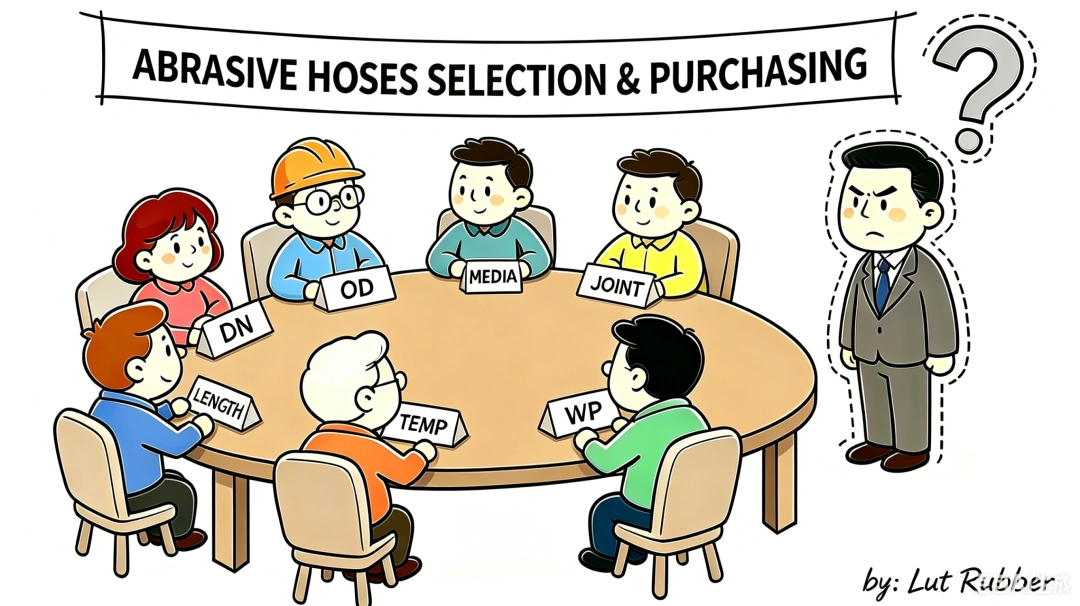
This cost difference explains why hoses with identical inner diameters carry vastly different market quotations: different suppliers offer products with inconsistent safety factors. Comparing prices without unifying safety factors is meaningless. From the global perspective of procurement management and project cost control, judging products solely by unit purchase price is a short-sighted idea.
Dredging sand pumping, mine drainage and slurry transportation hoses operate under long-term high pressure and severe abrasion. The safety factor defines the hose’s burst safety margin. Low-safety-factor hoses consume fewer raw materials and carry lower quotations, yet they lack sufficient safety redundancy. Their failure risk rises sharply during long-term continuous operation. Once rupture or leakage occurs, it will trigger a chain of economic losses including production shutdown, material spillage, on-site maintenance and hose replacement. Hoses with higher safety factors have higher upfront raw material costs, yet they feature stronger structural bearing capacity, lower failure frequency and lower full-lifecycle comprehensive losses.
Practical suggestions for purchasers and manufacturers:
- For Purchasers: Clarify the safety factor required by the project before procurement, take long-term maintenance costs into consideration, and treat low-price products rationally.
- For Manufacturers: Clearly mark safety factors in quotation details, recommend products matching clients’ working conditions, and objectively illustrate cost differences and service risks of each safety grade.