In the procurement scenarios of heavy-duty hoses for dredging, slurry, steel mills, and concrete transportation, both buyers and suppliers will check all visible parameters of abrasive hoses, including caliber, outer diameter, conveying medium, working pressure, joint specifications, and pipe length. However, the hoses burst and fail shortly after installation and operation, far failing to reach the standard service life.
Then ?
For Project Owners: Unexpected hose bursts lead to emergency production line shutdowns, material leakage and loss, and delayed project progress.
For Buyers: It results in contract disputes with suppliers, or urgent re-sourcing and repeated procurement, causing extra time and cost losses.
For Suppliers: Companies have to compensate or replace products to honor warranty commitments, which damages brand reputation and credibility.
Why & How ?
Hose bursts are external manifestations of insufficient pressure resistance. When it comes to pressure bearing performance, working pressure and burst pressure work together like a team of father and son to determine the overall pressure resistance of slurry hoses. Working pressure bears conventional daily operating conditions and is the most concerned parameter in slurry hose selection. In contrast, burst pressure is a hidden core indicator that represents the maximum pressure resistance limit, coping with harsh and high-intensity working conditions. The safety factor, the key parameter connecting these two indicators, is frequently overlooked in slurry hose procurement and selection, which is the core cause of early hose burst failure.
What is a slurry hose safety factor? It refers to the ratio of the hose’s ultimate burst pressure to its rated working pressure, serving as a core indicator to measure the slurry hose’s pressure bearing redundancy, impact resistance, and wear resistance. Once the safety factor is confirmed, the minimum burst pressure of the hose is fixed. For example, for a hose with a maximum working pressure of 10 bar, a safety factor of 3.0 corresponds to a minimum burst pressure of 30 bar, while a safety factor of 4.0 corresponds to 40 bar.
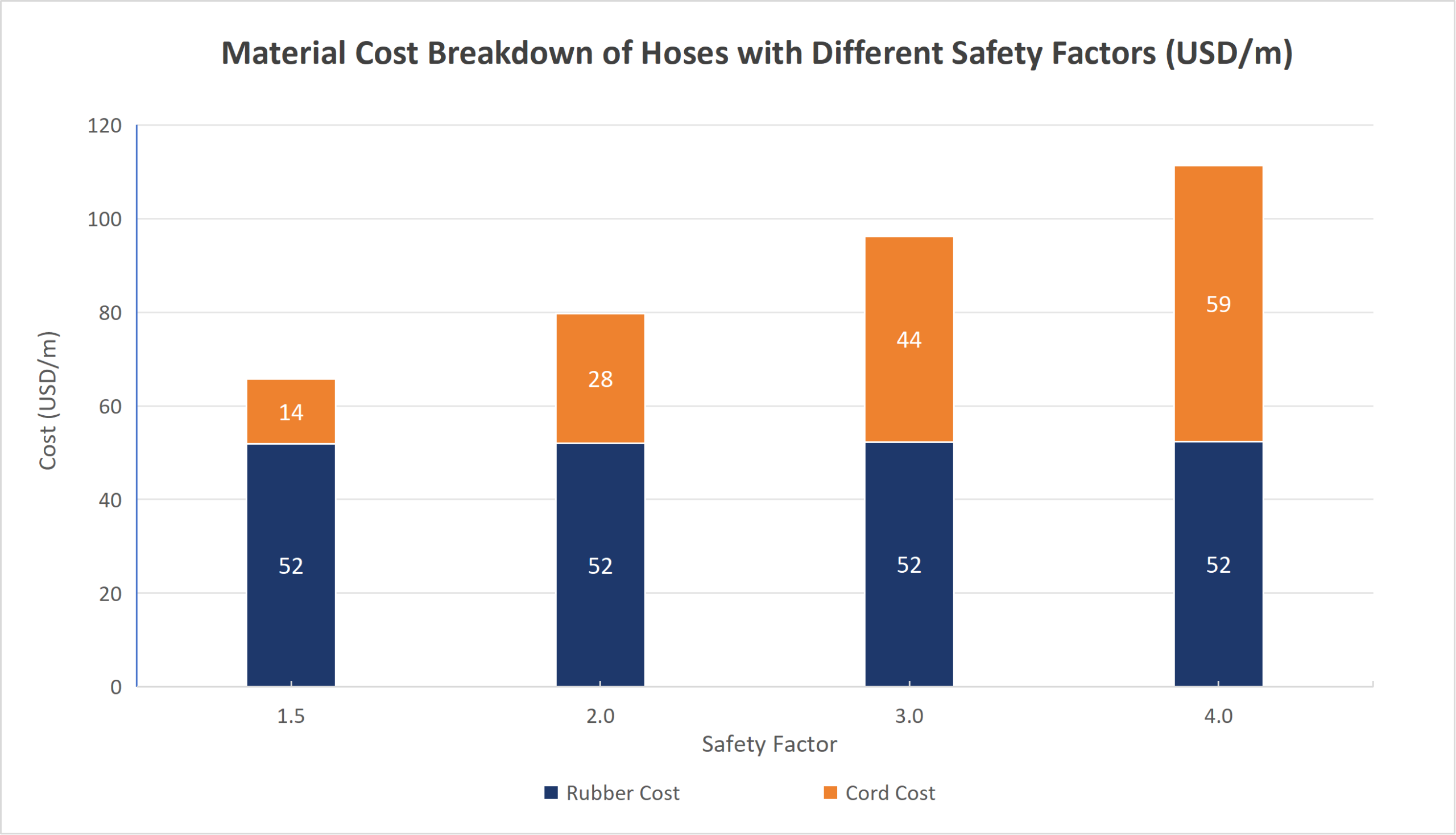
The structural design, manufacturing technology, material selection, and cost accounting of abrasive hoses are all based on the minimum burst pressure. An excessively low safety factor will lead to potential safety hazards, while an unnecessarily high safety factor will result in wasted procurement costs. For deeper insights into safety factors, Lut Rubber analyzes cost variations across safety factor grades. Click to read.
Therefore, selecting a targeted safety factor according to actual working conditions is essential. A reasonable safety factor defines the minimum pressure resistance limit and burst pressure standard of slurry hoses, unifies the selection standards for buyers and suppliers, completely solves the problem of sudden slurry hose bursts, and realizes the perfect balance of working condition adaptation, parameter matching, operational safety, and cost control.
Lut Rubber abrasive hoses adopt a full-range adaptable safety factor of 1.5-4.0 with no fixed standard, fully customized for diverse working conditions. The 1.5-2.0 basic safety factor is applied for light and stable working conditions to control procurement costs effectively. For harsh heavy-duty scenarios with high impact and severe wear, such as dredging, slurry transportation, and steel mill hose applications, a high safety factor of 3.0-4.0 is configured to ensure stable and durable operation.
If you have encountered slurry hose failure problems or relevant inquiries, feel free to contact us for professional consultation and quotation.