
Your Price Is Too High ! Quantitative Analysis of Safety Factor and Raw Material Cost Of Abrasive Hoses.
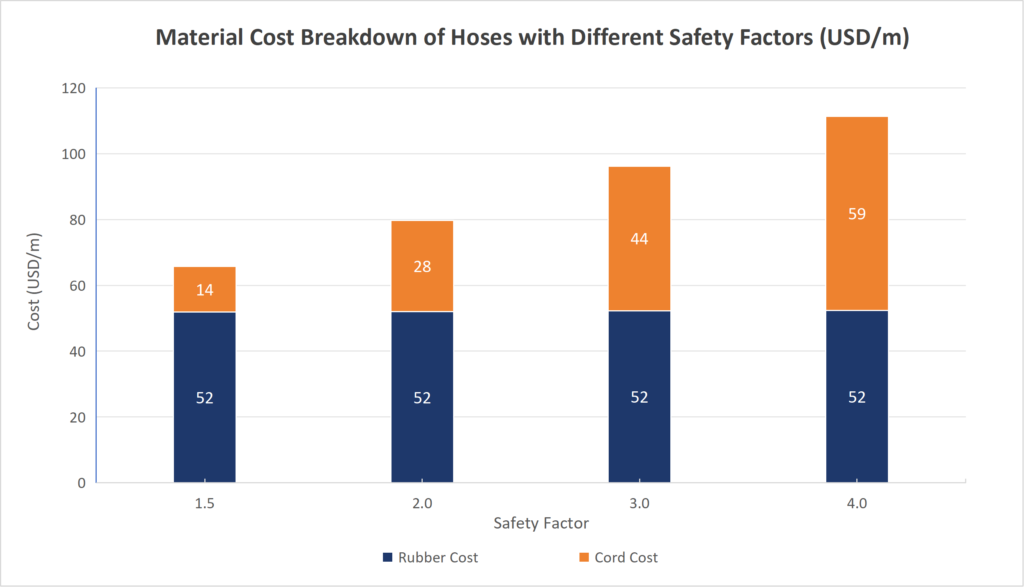
Many clients question the high quotation of abrasive hoses for dredging and mining. This paper takes a 450 mm dredging hose as the sample to analyze raw material costs, only calculating material expenses without labor and manufacturing overheads. The calculation shows that higher safety factors require more layers of cord reinforcement, driving up raw material costs sharply. At the safety factor of 4.0, the cost of cord reinforcement surges by over 320%. Many purchasers simply compare unit prices while ignoring differences in safety factors, which easily leads to wrong selection decisions. Combined with high-pressure and abrasive working conditions, this paper compares the long-term service pros and cons of hoses with different safety factors. Practical suggestions are provided for both purchasers and manufacturers, guiding all parties to abandon the mindset of only focusing on unit price and conduct rational selection and quotation based on product safety standards and full-lifecycle comprehensive costs.
Abrasive Hose Bursts After Only Three Days of Use? Which “Key Factor” Is Missing in Procurement Selection

Most abrasive hose burst failures within a short service life are not caused by wrong conventional parameters, but by the missing of the safety factor in procurement selection. Working pressure and burst pressure jointly determine slurry hose pressure resistance, while the safety factor bridges the two core indicators. A matched safety factor (1.5-4.0 customized) helps avoid potential safety hazards and cost waste, balancing operational safety and procurement economy for dredging, slurry, steel mill and concrete hose systems.